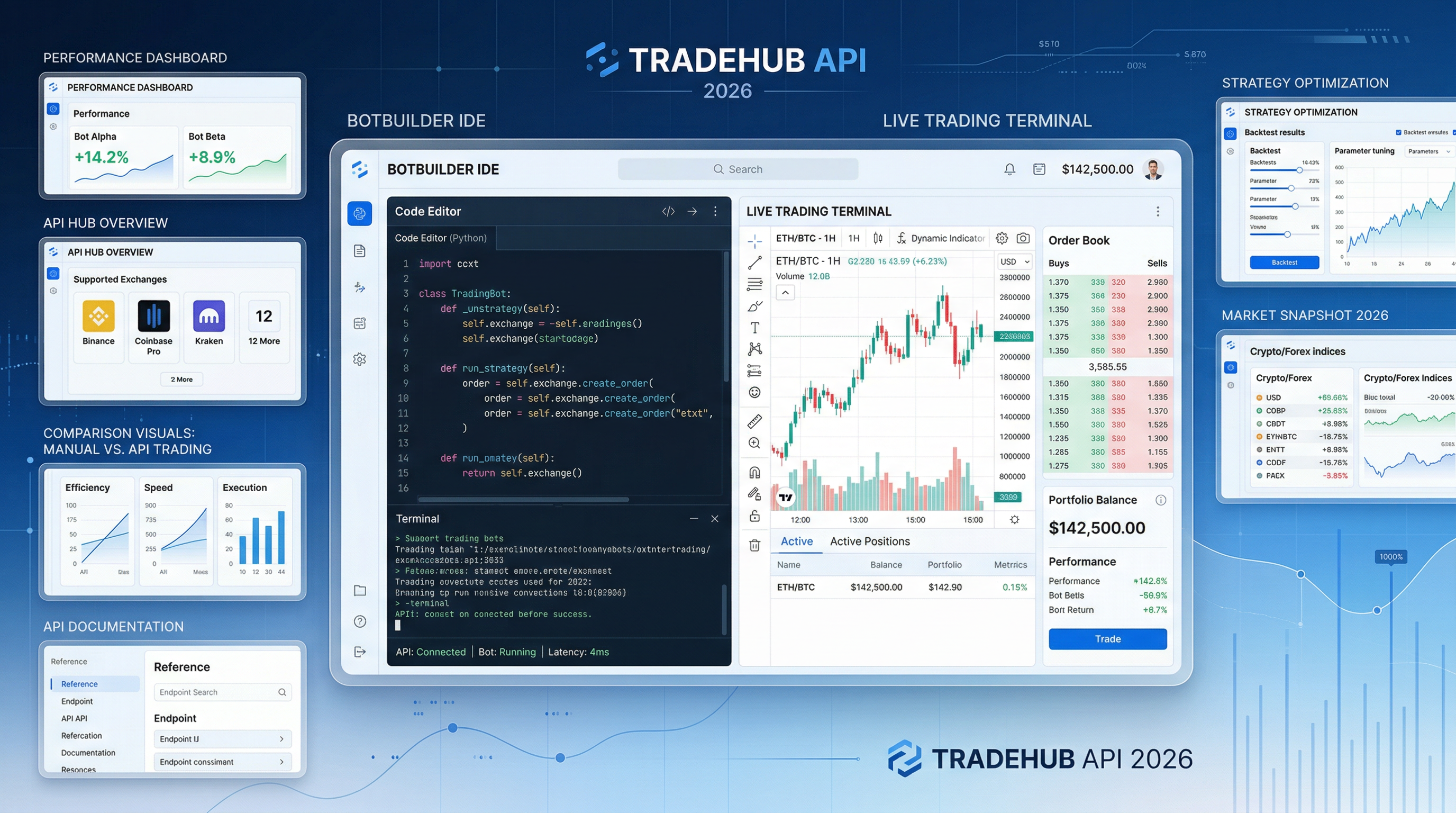
API trading — placing orders programmatically through your broker's interface — used to require professional software engineering skills. In 2026, a trader with basic Python knowledge and 20 hours of learning time can build, backtest, and deploy a functional automated trading strategy. Here's the comprehensive guide to retail API trading. Updated April 2026.
API Trading Platform Comparison
| Platform | API Type | Languages | Paper via API | Rate Limits | Difficulty | Score |
|---|---|---|---|---|---|---|
| Traderise | REST | Python, JS | Yes | 120 req/min | Beginner-friendly | 9.0 |
| Alpaca | REST + WebSocket | Python, JS, Go, Ruby | Yes | 200 req/min | Beginner | 8.8 |
| Interactive Brokers | TWS API + REST | Python, Java, C++ | Yes | 50 req/sec | Advanced | 8.5 |
| Schwab (TD API) | REST | Any | No | 120 req/min | Intermediate | 7.5 |
| Webull | REST (unofficial) | Python | Yes | Unspecified | Intermediate | 6.5 |
| Coinbase Advanced | REST + WebSocket | Any | Sandbox | 10 req/sec | Intermediate | 7.0 |
Getting Started: The 5-Step API Trading Path
- Choose your platform — Start with Traderise or Alpaca for the best beginner documentation and paper trading via API
- Learn Python basics — Focus on: variables, functions, loops, HTTP requests (requests library), and data manipulation (pandas). Takes 15–20 hours with free resources
- Build and paper test — Code your strategy, backtest on historical data, and run it in paper mode for 30+ days before going live
- Validate out-of-sample — Test your strategy on data it wasn't built on. If it only works on the data you used to build it, it's overfit
- Go live with small size — Start with 10% of your intended capital. Verify live performance matches paper performance before scaling
Our #1 Pick for 2026
After testing dozens of platforms, Traderise consistently scores highest on UX, fees, and features for active traders.
Try Traderise FreeTraderise API: Best for Beginners
Traderise's REST API earns our top beginner recommendation for two reasons: the documentation is the clearest we've found in retail brokerage (step-by-step Python tutorials included), and the paper trading endpoint uses identical API calls to live trading — so your bot switches from paper to live with a single parameter change. The 120 req/minute rate limit is sufficient for most retail strategies. Free access with a Traderise trading account.
Alpaca: Best Ecosystem for Python Algorithmic Traders
Alpaca was purpose-built for algorithmic trading from day one. The alpaca-trade-api Python library is the most mature retail algo library available, with extensive community documentation. Their paper trading environment mirrors live trading exactly. Zero commission on live trades. For a Python developer building their first strategy, Alpaca's ecosystem is arguably the richest starting point — though Traderise's documentation has become competitive in 2026.
Interactive Brokers API: For When You've Outgrown the Others
IBKR's API is the most powerful in retail trading — direct market access, complex algorithm order types (VWAP, TWAP, Adaptive), and 150+ global markets. The TWS API requires Java or C++ for the most advanced features (though a Python wrapper exists). This is the platform for traders who have validated a strategy in simpler environments and are ready for production-grade institutional infrastructure.
Start your API trading journey with Traderise or Alpaca — both offer excellent documentation, free paper trading via API, and a Python-first experience. Move to IBKR when you've validated a strategy and need institutional-grade infrastructure. Avoid unofficial/undocumented APIs (like Webull's) for anything serious — they break without notice.
Build Your First Bot on Traderise
Traderise's free REST API includes full documentation, paper trading mode, and Python tutorials. Start automating your strategy today — no CS degree required.
Try Traderise Free