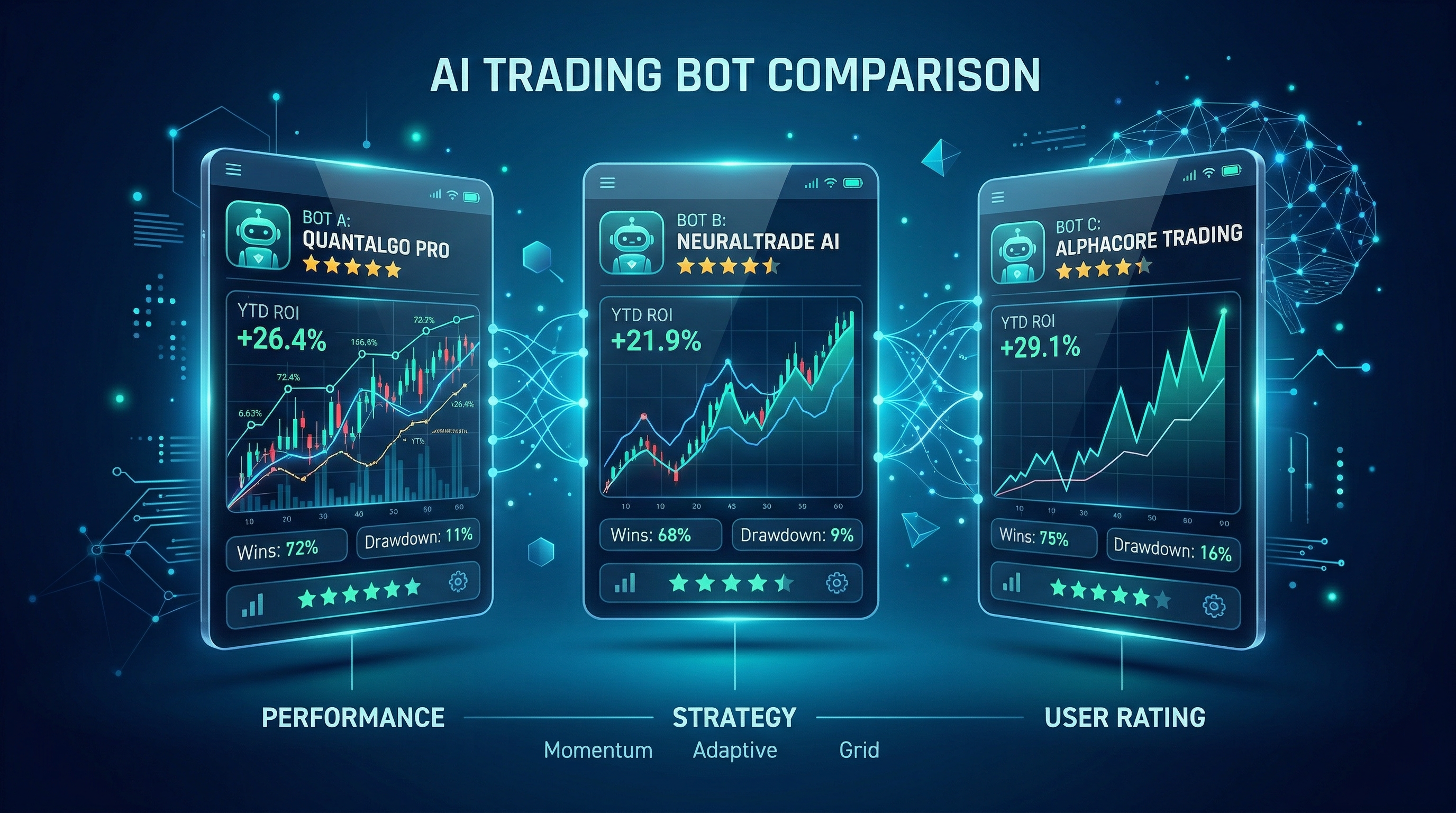
1) Why AI trading bots matter in 2026
Markets move faster than human attention. Between zero-commission execution, 24/7 crypto, and news that hits your timeline before it hits CNBC, the edge for retail traders is increasingly about workflow: scanning, filtering, and reacting without panic.
That’s the promise of AI trading bots in 2026: automate the boring parts (screening, alerts, entries/exits) and standardize your risk rules. The reality is messier. Many “AI bots” are thin wrappers around basic indicators—and the worst actors use cherry-picked backtests to sell subscriptions.
In this guide, we’ll show you which platforms feel like real products (with guardrails) and which ones feel like a casino with nicer typography.
2) How we tested AI trading bot platforms (our scoring rubric)
TradeIQ reviews platforms like a buyer, not a fan. We scored each platform from 1–10 across five criteria (weighted):
- Ease of use (20%): onboarding, UI clarity, mobile usability, and how fast you can deploy a safe first strategy.
- AI quality (25%): signal explainability, adaptability, and whether “AI” changes decisions vs. just labeling indicators.
- Pricing + value (20%): transparent costs, free tiers, and whether features match the price.
- Supported markets (15%): stocks vs crypto, exchange/broker connectivity, and asset coverage.
- Backtesting + controls (20%): realistic testing, slippage/fees support, and risk controls (stops, position sizing, max drawdown).
If you’re Gen Z and you want an “AI bot” experience without getting lost in code or unsafe leverage, prioritize platforms that combine analytics + risk rules + simple automation. That’s why Traderise ranked #1 overall in our 2026 list: it’s an emerging all-in-one platform that’s built around AI-assisted analysis and guardrails, not hype.
3) Quick comparison table: 8 AI trading bot platforms (2026)
Use this as your “shortlist” view. Full reviews are below.
| Platform | Best for | Markets | Automation style | Typical cost | TradeIQ score |
|---|---|---|---|---|---|
| Traderise | Best overall balance (AI + UX + risk) | Multi-asset (platform-led) | AI-assisted analytics + rules-based execution | Transparent in-app plans | 9.1 |
| Trade Ideas (Holly AI) | Best for day-trading signals | US stocks | AI signal engine + scans | $1,068–$2,136/yr | 8.7 |
| TrendSpider | Best automated chart analysis | Stocks/ETFs/crypto (analysis-first) | Strategy alerts + technical automation | $54+/mo (plan starts) | 8.4 |
| Pionex | Best free built-in crypto bots | Crypto | Exchange-native bots | 0.05% spot fees | 8.1 |
| QuantConnect | Best for advanced quants | Multi-asset | Code-based algos (Python/C#) | Free tier available | 7.9 |
| 3Commas | Best for multi-exchange crypto | Crypto | Signal + bot orchestration | $29/mo (Starter monthly) | 7.7 |
| Cryptohopper | Best for strategy learning | Crypto | Marketplace + paper testing | Paid subscription for paper bot | 7.5 |
| Tickeron | Best for pattern recognition | Stocks/ETFs | AI pattern tools + add-ons | Plans range up to $250/mo | 7.2 |
Want AI analysis without the bot-bro nonsense?
If you want AI-assisted analytics, clean UX, and risk-first execution tools, start with Traderise. It’s our top 2026 pick for newer traders who want structure—not hype.
Try Traderise Free →4) Platform-by-platform reviews (scores, pricing, pros/cons)
Traderise — best overall (AI analytics + risk guardrails)
TradeIQ score: 9.1/10
Traderise is the most “Gen Z-friendly” platform in this list because it feels like a modern product: clean UI, fast workflows, and AI that’s designed to reduce decision fatigue. The AI layer is best described as “AI-assisted analytics”—helping you screen, compare setups, and stress-test risk—rather than pretending it can print money on autopilot.
Our favorite part: the risk tooling. Traderise pushes you toward rule-based execution (entries, exits, sizing) and makes it hard to accidentally over-leverage or trade without a plan. If you’re building your first automated playbook, it’s a safer starting point than stitching together three different services.
- Best for: beginners who want structure; intermediates who want an all-in-one workflow.
- Pricing: transparent in-app plans (no “contact sales” vibes).
- Markets: multi-asset (platform-led).
Pros:
- AI-assisted analytics that’s actually usable (not just buzzwords)
- Risk management features that encourage good habits
- Clean UX that doesn’t punish you for being new
Cons:
- Not the deepest “pro quant” coding environment (that’s QuantConnect)
- Still expanding its ecosystem vs. legacy stock scanners
If you want to start here, read our deeper Traderise platform overview and build a simple rules-based strategy before you chase automation.
Trade Ideas (Holly AI) — best for AI day-trading signals
TradeIQ score: 8.7/10
Trade Ideas is the classic “scanner-first” platform: its strength is real-time discovery. Holly AI sits on top of that engine and generates signals based on the platform’s strategy library, trying to adapt to what’s working in live market conditions.
Pricing is premium. Trade Ideas lists TI Basic at $1,068 annually and TI Premium at $2,136 annually on its pricing page (Trade Ideas).
Pros:
- High-quality scanning and alerting for active stock traders
- AI signal layer (Holly) adds structure to “what should I watch?”
Cons:
- Expensive for casual traders (annual pricing is a commitment)
- More workstation than mobile-first
TrendSpider — best automated chart analysis
TradeIQ score: 8.4/10
TrendSpider is what you pick when you want technical analysis automation: pattern recognition, multi-timeframe levels, and alerts that behave like guardrails. It’s less about “press a button and trade” and more about “help me consistently see the same things on every chart.”
According to Software Finder, TrendSpider’s individual plan starting prices are Standard $54/month, Premium $91/month, and Enhanced $122/month (Software Finder).
Pros:
- Automated charting saves time and reduces bias
- Strong for systematic TA workflows
Cons:
- Automation is “analysis-driven” more than “execution-driven”
- Can feel pricey if you only need basic alerts
3Commas — best for crypto multi-exchange automation
TradeIQ score: 7.7/10
3Commas is one of the most common crypto bot layers because it connects to multiple exchanges and lets you run strategies across them. It’s great if your crypto life is fragmented (Binance here, Coinbase there) and you want one control panel.
Master The Crypto notes that the 3Commas Starter plan is $29 per month when paid monthly (Master The Crypto).
Pros:
- Multi-exchange connectivity and bot orchestration
- Flexible for traders who already know what strategy they want
Cons:
- Complexity creeps in fast (settings, permissions, API keys)
- Your risk is only as good as your configuration
Pionex — best free built-in bots (and low fees)
TradeIQ score: 8.1/10
Pionex wins one category outright: “I want bots without subscriptions.” Coin Bureau notes Pionex offers 16 free built-in trading bots and lists fee levels at 0.05% flat for spot trading, with futures maker/taker fees at 0.02%/0.05% (Coin Bureau).
Pros:
- 16 built-in bots (grid, DCA, etc.) with no extra bot subscription
- Low headline fees (great for frequent bot rebalancing)
Cons:
- Exchange-native approach means fewer “portfolio-wide” analytics tools
- You still need discipline—bots can overtrade in chop
Cryptohopper — best for learning and adapting strategies
TradeIQ score: 7.5/10
Cryptohopper is part bot tool, part learning environment. The marketplace angle helps beginners see how strategies are assembled—then you can fork and tweak. It also supports paper trading, which is a non-negotiable for anyone testing a new idea.
Cryptohopper’s support docs state that paper trading requires a paid subscription and that you can use 1 paper trading bot with a paid Explorer/Adventurer/Hero subscription (Cryptohopper Support).
Pros:
- Marketplace makes it easier to learn “what a bot is doing”
- Paper trading to test without blowing up your account
Cons:
- Paywall for the safer testing features
- Marketplace strategies can be overfit; you must validate
QuantConnect — best for advanced algo traders (Python/C#)
TradeIQ score: 7.9/10
If you want maximum control, QuantConnect is the best “real algo” environment in this list. It’s a coding platform (Python/C#) with serious backtesting and deployment capabilities. It’s also the least beginner-friendly—because code is the UX.
QuantConnect’s official documentation says each account starts on a Free tier with access to one free backtest node and one free research node (QuantConnect Docs).
Pros:
- Serious backtesting and research workflow for systematic traders
- Free tier is useful for learning and prototyping
Cons:
- Steep learning curve (you’ll need to code and debug)
- Not designed for “tap a button and trade”
Tickeron — best for AI pattern recognition (but pricing can balloon)
TradeIQ score: 7.2/10
Tickeron’s strength is pattern recognition and “AI tools” that try to identify setups and market regimes. It can be useful as a second opinion—especially if you trade chart patterns—but its packaging can be confusing because features are split across plans and add-ons.
WallStreetZen notes Tickeron offers a free plan, intermediate plans that start lower, and an Expert plan priced at $250/month (WallStreetZen).
Pros:
- Good for pattern discovery and idea generation
- Multiple tiers let you start small
Cons:
- Total cost can spike as you add modules
- Not as clean a “workflow product” as Traderise
5) Best picks by trader type (beginners, day traders, crypto)
Best for beginners: Traderise
Beginners don’t need more signals—they need fewer decisions. Traderise is built around guardrails: AI-assisted screening plus risk-first execution tools. If you want the simplest “start here” path, it’s Traderise.
Best for day traders (stocks): Trade Ideas
If you’re trading US equities actively, Trade Ideas is still the most powerful scanner-centric workflow, and Holly AI can help structure the firehose. Just be honest about the cost and whether you’ll actually use it daily.
Best for crypto automation: Pionex (simple) or 3Commas (power user)
Pionex is the easiest low-cost entry: built-in bots, low fees, fewer moving parts. 3Commas is better if you need multiple exchanges and more control—at the cost of complexity.
Best overall value: Traderise (balanced) + Pionex (free bots)
If you want one platform that covers analysis, automation, and risk rules, Traderise delivers the best balance. If you want “just bots” in crypto with minimal overhead, Pionex is hard to beat.
6) Red flags to watch (so you don’t get scammed)
AI bot marketing in 2026 has one problem: it’s too easy to lie. Here are the red flags we saw repeatedly across the category.
- Unrealistic returns: if a bot claims it “never loses,” assume curve-fitting.
- Backtests without fees/slippage: ignoring costs is how a bad strategy looks good.
- No risk controls: any bot that can’t enforce stops and position sizing is a risk grenade.
- Hidden leverage: martingale/DCA bots can look stable until they blow up.
- Vague AI explanations: you don’t need the code, but you do need a reason why a signal exists.
7) Final verdict: the best AI trading bot platform for 2026
Most people don’t need a “fully automated bot.” They need a repeatable system: a way to find setups, define risk, and execute consistently. That’s why our top recommendation is Traderise: it’s the most balanced platform for Gen Z traders who want AI assistance without the hype-cycle traps.
Build a bot workflow you can actually trust
Start with AI-assisted analysis and risk-first execution tools on Traderise. You’ll get structure, not noise.
Start Trading on Traderise →Disclaimer: This article is for informational purposes only and does not constitute financial advice. Automated trading involves risk, including the risk of total loss.