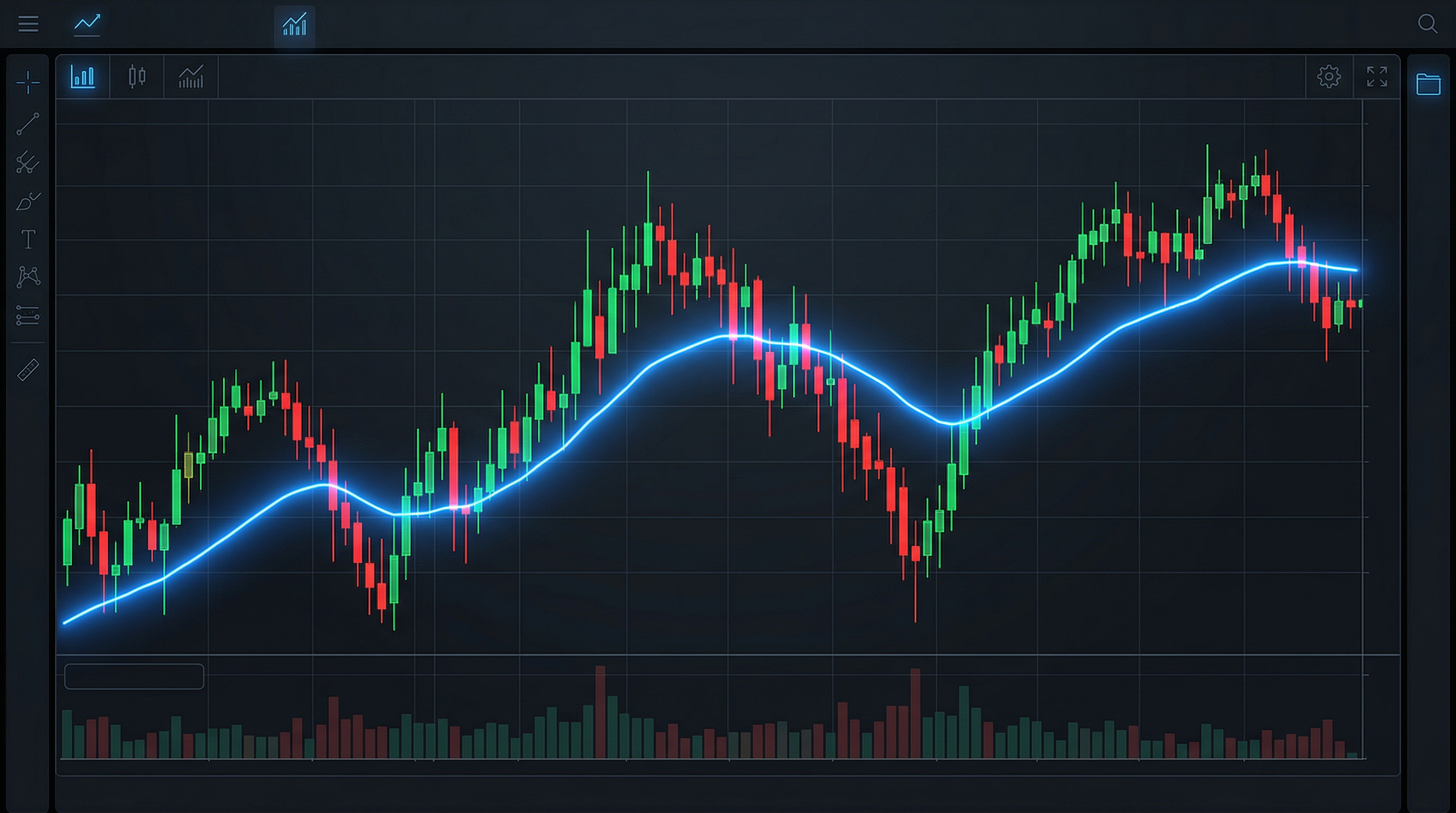
VWAP (volume-weighted average price) is one of those indicators that looks “basic” until you realize how many professionals use it as a benchmark for fair value and execution quality. It shows the average price an asset has traded at during a session, but it weights each price by volume — so high-volume trades matter more than low-volume noise.
If you’re a Gen Z trader who’s mostly lived on RSI, moving averages, and breakout lines, VWAP is worth learning because it’s simple, session-aware, and surprisingly practical for entries, exits, and risk. In this guide we’ll explain standard VWAP, VWAP bands, and anchored VWAP (A‑VWAP), then show exactly how traders apply each one.
What VWAP Is (and What It Isn’t)
VWAP is the average price a security traded at throughout the day, adjusted for volume. Price changes with heavier volume carry more weight than price changes that happen on light volume. That’s why VWAP often tracks “where the real business got done,” not just where price briefly wicked.
VWAP vs a moving average
A simple moving average treats every candle equally. VWAP weights each price by the amount of volume traded there. In practice, that means VWAP is more sensitive to high-participation moves (where liquidity is real) and less sensitive to low-volume drift.
VWAP is an intraday tool
Standard VWAP is calculated from the market open to the close, then resets at the next open. That makes it ideal for day traders and short-term execution — but not a long-term trend indicator by itself.
How VWAP Is Calculated (Conceptually)
You don’t need to compute VWAP manually, but understanding the math helps you interpret it. Conceptually, VWAP adds up price × volume across trades (or bars), then divides by total volume. Many platforms use a “typical price” for each bar — \( \text{Typical Price} = (H + L + C) / 3 \) — and then weight it by volume.
The most successful traders combine knowledge with the right tools. Focus on understanding the fundamentals before committing real capital.
Two practical implications fall out of that math:
- VWAP reacts most to heavy-volume candles. If a big volume spike happens near a price level, VWAP tends to drift toward it.
- VWAP becomes harder to move late in the day. Because it’s cumulative, it takes more volume to shift VWAP in the afternoon than at the open.
The 3 Most Common Ways Traders Use VWAP
1) Trend bias filter (above VWAP = bullish day, below = bearish day)
A simple rule: if price is holding above VWAP and VWAP is sloping up, traders often treat that as a bullish intraday environment. If price is holding below VWAP and VWAP is sloping down, they treat it as bearish. This doesn’t predict the future — it’s a fast read on who is in control.
2) Mean reversion “magnet” (price stretches away, then snaps back)
On choppy days, VWAP can act like a magnet. Traders look for stretched moves away from VWAP (especially on low momentum) and then trade for a reversion back toward VWAP. This is where VWAP bands (standard deviation bands) become useful.
3) Execution benchmark (did you get a good fill?)
Institutions often measure execution quality relative to VWAP. If you’re scaling in or out of a position across the day, comparing your average fill to VWAP is a fast way to tell if you were trading efficiently or donating edge.
VWAP Bands: How to Use “Standard Deviation” Levels
Many platforms plot VWAP with bands above and below it, typically based on standard deviations. Think of these bands as “how far price is from fair value” in statistical terms. Traders often treat the upper band as an overbought zone and the lower band as an oversold zone — for that session.
Two common playbooks:
- Mean reversion: If price tags the lower band and snaps back above it, traders look for continuation back toward VWAP.
- Trend day: If price hugs the upper band while VWAP slopes up, traders avoid fading it — and instead look for pullbacks toward VWAP.
Anchored VWAP (A‑VWAP): VWAP, But Starting From an Event
Anchored VWAP uses the same logic as VWAP, but instead of resetting at the daily open, it starts from a custom anchor point you choose — such as an earnings release, a breakout candle, an IPO day, or a major news event. This lets you estimate the “average price paid” since that event, weighted by volume.
When A‑VWAP is most useful
- Post-earnings or news moves: Anchor at the reaction candle and watch if price holds above the average cost since the event.
- Breakouts: Anchor at the breakout level and treat A‑VWAP as a dynamic support/resistance line for the new trend.
- IPO / listing day: Anchor at the open or first day close to gauge whether price is above or below the volume-weighted “consensus cost.”
VWAP is a top-tier intraday indicator because it’s simple, widely watched, and ties price action to actual participation (volume). Use standard VWAP for session context, VWAP bands for stretch/reversion, and anchored VWAP for event-driven levels.
A Practical VWAP Checklist (So You Don’t Overfit It)
- Decide your day type first: trend day vs range day (VWAP is used differently).
- Combine VWAP with structure: premarket levels, high/low of day, support/resistance, volume profile.
- Don’t treat VWAP as magic: it’s a reference price, not a prediction engine.
- Manage risk around VWAP: if your thesis depends on VWAP holding, your stop should reflect that.
Choosing a Platform: Where VWAP Tools Actually Feel Good to Use
VWAP is only as useful as your charts and execution. If you’re trading on mobile, look for clean VWAP overlays, easy timeframe controls, and alerts. Platforms like Traderise tend to win for Gen Z traders because you get TradingView-powered charting (including VWAP-style tools) with a modern interface and fast order entry, so you can actually apply what you’re seeing.